
Cost, release, and the two-lawful-brand market that bookmakers in New Zealand actually offer
 Available in US
30 October 2026 · verified against the Racing Industry Act 2020 (as amended 2025) and TAB NZ’s own app listing

This review asks a different question from the one a typical “best bookmakers” page asks. A New Zealand punter is not choosing between ten equal brands. Section 74AAA of the Racing Industry Act 2020, in force since 28 June 2025, names TAB NZ as the only operator that may lawfully offer betting services in this market, and Betcha is its online sister brand. Everything else in the ten-name shortlist runs offshore, outside New Zealand law, outside the Department of Internal Affairs’ complaints reach, and outside the harm-minimisation framework TAB NZ is bound by. That is not a ranking and not a recommendation. It is the cost a New Zealand reader pays the moment a betting account is opened with a brand this page cannot describe as licensed here.
So the angle of this page is cost. What does it cost to bet with TAB NZ and Betcha, and what does it cost to bet anywhere else, including the offer terms that look generous and the rules that decide whether the payout actually arrives. The arithmetic that decides both questions is the same: a bookmaker’s margin sits inside every price, and a bonus term turns that margin into the cost of clearing the offer. That is the lens each section holds.
The ten names reviewed here are TAB and Betcha first, because they are the only lawful option, then eight brands a New Zealand reader will encounter but cannot legally bet with through New Zealand law. The comparison table sits near the end of the page, after the legality, responsible-gambling, payments, mobile and markets sections have set the frame it operates inside.
Table of Contents
- Crypto and anonymity: what an offshore bookmaker actually sells a New Zealand punter
- Bonuses, free bets and the rollover that decides what an offer actually costs
- Payments, payout speed and what the cashier page actually settles
- Mobile, app and the device a New Zealand punter actually bets on
- Bet types, odds and the margin that decides what a market really costs
- Sports, tournaments and the fixtures a New Zealand punter bets on
- The top ten bookmakers in New Zealand: what each one offers and what each one costs
- Comparison table: ten bookmakers a New Zealand reader meets
- The fundamentals: what a bookmaker is and what it does
- Legality and regulation: who oversees what in New Zealand
- Responsible gambling and the harm-minimisation framework TAB NZ is bound by
- How to read this page if you are deciding where to bet
- Frequently Asked Questions
Crypto and anonymity: what an offshore bookmaker actually sells a New Zealand punter
New Zealand law does not regulate crypto payments to betting operators the way it regulates the operator itself, and nothing in the Racing Industry Act 2020 or in the Gambling Act 2003 names a crypto asset, a wallet or a VPN as either permitted or banned for placing a bet. What the law does, clearly, is name the operator side. An offshore bookmaker taking racing or sports bets from a person in New Zealand is in breach of section 74AAA. The brand, not the wallet, is where the liability sits.

That is the frame any crypto-friendly offshore bookmaker enters this page inside. Crypto is a payment rail. Anonymity is marketing. Neither changes the legal position of the brand offering it, and neither gives the punter a New Zealand complaints route if a payout is delayed, capped or refused. The Department of Internal Affairs warns that offshore operators may be in jurisdictions with minimal consumer safeguards, may not return unspent credits and may not pay out large wins. A punter who picks a crypto bookmaker because the deposit looks quicker is buying speed at one end of the transaction and accepting risk at the other.
Telbet is the clearest case on the shortlist. The brand describes itself as a crypto casino and sportsbook. Its Russian-language site lists a welcome offer of 200% up to 1 BTC plus 50 free spins and a 5 USDT free bet, and the welcome alone is the kind of figure that earns a closer read, not a faster click. A “200% up to 1 BTC” headline means the bonus base is the deposit, and a 200% match turns a $10 deposit into $30 of playable balance before any rollover term is met. The rollover term is where the cost shows up; it is rarely printed at the same size as the headline.
Thunderpick sits one step along the same spectrum. It is operated by Paloma Media B.V., a Curaçao company under Curaçao Gaming Authority licence OGL/2024/677/0722, and the licence number matters only as far as it answers the question “where does this brand sit if a dispute reaches a regulator?” The answer is Curaçao, not New Zealand. The DIA’s stated risk warnings are the operative answer here, and Curaçao is precisely the kind of jurisdiction those warnings describe.
Roobet, by Raw Entertainment B.V. under Curaçao licence OGL/2024/687/0427, runs the same shape: brand name on the front, Curaçao registration on the back, no New Zealand oversight. The marketing is the marketing. The legal address is the legal address. A New Zealand punter who reads the marketing page and skips the terms is making a choice the law does not protect.
The cost a New Zealand reader pays for the crypto-friendly offshore route is, in this order: a deposit that may or may not be recoverable in the operator’s house terms, a bonus whose rollover term inflates the bookmaker’s margin into a required turnover, a withdrawal that may be paused for a source-of-funds check the New Zealand punter has no domestic route to escalate, and a complaint that has no domestic destination. None of those costs is on the welcome banner.
Bonuses, free bets and the rollover that decides what an offer actually costs
Bonuses are framed as giveaways. They are priced. A “100 % up to” bonus means a deposit is doubled into a playable balance; the price is the rollover, expressed as a multiple of the bonus (or the bonus plus the deposit, depending on the term) that must be turned over at a minimum price before any of it becomes withdrawable. The bookmaker’s margin, which sits inside every leg of every market, accumulates across every bet placed to clear the bonus. That is the cost. The headline is the cover charge.

TAB NZ and Betcha run “bonus bets” promotions inside the New Zealand-only framework. TAB NZ lists a Mega Multi bonus of up to $50 in Bonus Cash when a multi of four or more legs falls short by a set number of legs, and the app description makes the structure plain: the bonus lands on losing multis, capped or capped at $50, with terms and conditions applying. A punter who reads the term learns the minimum price per leg, the eligible markets, and the deadline. A punter who skips the term reads “up to $50” and assumes the worst-case payout. The honest read is the terms page.
Offshore brands make the bonus terms less legible on purpose. A 200% headline (Telbet) is a deposit tripler; the rollover, the minimum price, the eligible markets and the cap on free-bet winnings are the four numbers that decide what the offer is worth. The first three are usually stated in a smaller font on a different page; the fourth is often phrased as “free bet stakes are not returned” or “winnings capped at 1x the free bet”. Both phrasings mean the same thing in arithmetic: a free bet that returns only the profit, not the stake plus profit, is worth less than a cash bet of the same nominal size.
Three numbers carry the cost of any welcome offer, and they are worth pulling out before any headline is read:
- Rollover multiple. The base the multiple applies to (bonus only, or bonus plus deposit) and the multiple itself. A 5x rollover on the bonus alone is the cheapest structure a brand can offer; a 40x rollover on the bonus plus deposit is the kind of figure that turns a $100 welcome into $4,000 of required turnover.
- Minimum price per qualifying bet. Decimal odds of 1.50 admit a lot of heavy-favourite bets that do most of the rollover volume cheaply. Decimal odds of 2.00 cut the same volume in half.
- Cap on free-bet winnings. A free bet whose cap is “winnings up to $500” is a hard ceiling, and the difference between that ceiling and an uncapped equivalent is the cost the brand has shifted onto the punter.
A cashback is the same shape in a softer wrapper. A “10 % cashback on losses” is a fraction of the stake returned on a losing week, and the value of that fraction depends on the bookmaker’s margin on the markets that produced the losing week. A 5 % margin market returning $25 cashback to a $250 losing stake is the same arithmetic as a 1 % margin market returning $5; the marketing does not tell the punter which margin they played through, and the terms usually do not either.
The honest read of any “best bookmaker joining offer” page is that the offer is priced, and the price is in the terms. A punter who reads the terms pays less than a punter who reads the banner.
Payments, payout speed and what the cashier page actually settles
The cashier is the seam between the brand and the punter’s bank. What it shows, what it costs and how long it holds the money are the three questions a New Zealand punter needs answered before any other.

TAB NZ runs a simplified wallet inside its apps. The published description names deposits and withdrawals, with the rider that the account is verified against a New Zealand address and ID before the wallet is fully usable. That is the New Zealand side: identity is verified, the operator is regulated, and the payout is settled to a New Zealand bank account. No offshore operator in this shortlist can match that payout path, because none of them sits inside the New Zealand framework at all.
Offshore cashier pages are an exercise in coverage gaps. BillyBets offers New Zealand in its country selector, and the only currency filter the page exposes is Euro. A New Zealand punter who registers a New Zealand address and then sees Euro as the only currency filter is being asked to hold their balance in a currency that is not theirs, take the FX risk on every conversion, and trust that the operator’s settlement engine handles the conversion honestly. The cashier page presents this as a setting; the punter pays for it as a cost.
SpinBetter.com sits behind a Costa Rica company (3-102-955890 LIMITADA, doing business as Sprut Group Limitada) under Anjouan licence ALSI-202607036-FI2. The licence is a piece of paperwork, not a New Zealand entitlement. The cashier page is where the speed and the cost live, and neither is improved by the licence number being printed at the bottom of the page.
Paripesa.io, operated by Onorio Limited in the British Virgin Islands under Anjouan licence ALSI-122405024-FI2, runs the same pattern: a foreign company, an Anjouan licence, and a cashier page that processes payments in currencies that may or may not include the New Zealand dollar. A New Zealand punter is, in every case, paying the FX cost and the withdrawal-cost asymmetry between the operator’s house terms and what a domestic bank has charged.
Payout speed is the variable the marketing copy tries hardest on. “Instant withdrawals” usually means the operator has released the funds from its own wallet; the receiving bank, the payment rail and any intermediary still take their own time. A brand that promises an instant payout to a New Zealand bank account is making a claim about its own systems, not about the receiving end. The honest version of the claim is “we release within X; the bank takes Y on top”.
The Payout share — the fraction of every dollar wagered that returns to punters across a market — is the inverse of the margin. A market priced at 1.90 / 1.90 carries a margin of about 5 % and a payout share of about 95 %; a market priced at 1.70 / 2.20 carries a margin of about 8 % and a payout share of about 92 %. The cashier does not show the margin. The odds do, every time. The punter who reads the odds reads the margin.
Mobile, app and the device a New Zealand punter actually bets on
TAB NZ publishes its betting app under the name “TAB – Racing & Sports Betting” in the New Zealand App Store, with the seller listed as New Zealand Racing Board and the first release dated 8 September 2014. The age rating on the App Store is 17+, and the app description states that customers must be 18 or over to bet. That is the New Zealand side: an app, a verifiable seller, an age gate, and a brand the New Zealand regulator oversees.

The app covers horse and harness racing, rugby union and rugby league, and other sports, pre-match and live. It carries Same Race Multis, Same Game Multis, one-tap Popular Multis, and a Place Extra option that backs runners to finish up to 10th in selected races. Trackside live race streaming runs inside the app with in-app betting, with racing form, Blackbook and Jockey Challenge tools beside the bet slip. That is a complete product for a New Zealand racing and sports punter, and it sits inside the same verified wallet as the desktop site.
Offshore brands are mobile-first by default, because offshore is where the marketing spend is. Betalright accepts customers aged 18 and over, runs a separate partners site at Partnersbetalright, and exposes its product through a mobile browser and a mobile web app. BigClash offers pre-match and live sports betting across international and local leagues, plus virtual sports and esports betting on FPS and MOBA titles, and the entire product is designed for a phone screen.
The cost a New Zealand punter pays on the offshore side is not the app. The app is usually fine. The cost is what the app does not show: the lack of a verified New Zealand identity on the account, the lack of a domestic complaints route, and the lack of the harm-minimisation tools the New Zealand app is bound to provide. The mobile experience is the same on both sides; the regulatory experience is not.
A punter who bets on a phone bets through the same margin and the same rollover as a punter on a desktop. The screen size does not change the price. The lack of identity verification does change who answers if the withdrawal stalls.
Bet types, odds and the margin that decides what a market really costs
A bookmaker’s odds are not a gift. They are a price, and the price includes a margin the operator keeps on every market. The arithmetic is plain: for a two-way market with decimal odds and , the payout share is , and the margin is minus that share.

Take a market priced at 1.90 on each side. The payout share is , and the margin is , or about 5 %. That is the band the better-priced mainstream markets sit inside. A market priced at 1.80 / 2.00 carries a payout share of , and a margin of about 5.3 %. The headline odds change by a decimal point; the margin moves by less than half a point.
A typical two-way market priced symmetrically around 1.90 carries a margin in the 4–6 % range. Asymmetric pricing widens that band, and exotic markets — correct score, first goalscorer, multi-leg accumulators — push it well past 10 %. The arithmetic is an illustrative example, not a snapshot of a current price. The result is stated as a band with its condition, not as a single figure.
TAB NZ offers Win, Place, Each Way, Quinella, Exacta, Trifecta, First Four, Double, Treble, Daily Double, Running Double, Quaddie and Big6, plus Multis and Same Game Multis. The exotic end of that list — Trifecta, First Four, Quaddie, Big6 — carries a much higher margin than the fixed-odds Win market. Punters chasing a big payout on a small stake are paying the highest margin per dollar staked; punters backing singles on a well-priced head-to-head market are paying the lowest. The punter’s job, on this side of the page, is to know which side of that line they are standing on.
Offshore brands compete on odds the same way TAB NZ does. The same 1.90 / 1.90 market appears on most two-way sports markets across the shortlist, with the better-priced events drifting toward 1.95 / 1.95 and the heavier-margin events sitting at 1.85 / 1.85 or worse. None of those odds are quoted on this page as a snapshot price, because odds change hourly and any snapshot is stale by the time the page is read. The honest read is the band: a typical two-way market on a major sport carries a margin in the 4–6 % range, and the punter who reads the margin reads the cost.
“Best odds” pages tend to compare two operators on the same event at one moment in time. The comparison is real; the moment is not. A market that was 1.95 / 1.95 on one site and 1.90 / 1.90 on another at 9:00 a.m. is 1.90 / 1.95 and 1.85 / 1.95 by 11:00 a.m., and the punter who closed the tab at 9:00 missed the change. The right question is not “who had the best odds at one moment”, it is “who runs the lowest margin across a typical day”, and that is a number the punter has to estimate from the markets they actually bet on.
Sports, tournaments and the fixtures a New Zealand punter bets on
TAB NZ’s app covers horse and harness racing, rugby union and rugby league, and other sports. Greyhound racing is closing in stages from 1 August 2026, and from that date offshore operators may not take bets on greyhound races either. That removes one of the racing codes from the schedule and one of the bet types from the programme.

Super Rugby Pacific, NRL, the Black Caps in cricket, the All Blacks, the Warriors, the Melbourne Cup and Cup Day are the fixtures a New Zealand reader will name unprompted. TAB NZ runs them all, with same-game multis and racing form tools alongside. The product is built for the local calendar.
Offshore brands carry the global calendar by default. Football leagues from the Premier League down, the Champions League, the NBA, NFL, MLB, cricket internationals and domestic T20 leagues, tennis majors and the full tennis tour, golf majors, MMA, boxing, and the Super Bowl all appear on the offshore shortlist. BigClash adds virtual sports and esports on FPS and MOBA titles; the esports classification under the Racing Industry Act is not established, and the legal status of an esports bet on an offshore bookmaker is a question the law does not answer cleanly.
The cost of the global calendar is that the markets a New Zealand punter knows best — Super Rugby, NRL, domestic cricket, harness racing, Melbourne Cup day — are priced by operators who do not know them. The margin on a thinly-priced All Blacks test is wider than the margin on an All Blacks test priced by TAB NZ, because TAB NZ has the local trading desk and the local liability profile. A punter who bets the Black Caps on an offshore bookmaker is paying a margin premium for the privilege of betting an event the bookmaker is pricing from the other side of the world.
The football question is the inverse. The Premier League, the Champions League, the World Cup and the European Championship are priced by every brand on the shortlist, and the margin on those events converges toward the lowest level any of them offers, because the betting volume is high and the books are sharp. A punter who bets the Premier League on an offshore bookmaker pays a margin close to what TAB NZ charges, and the offshore choice on that market is closer to a coin flip on price than a meaningful edge.
The Super Bowl, the Champions League final, the Melbourne Cup — the marquee fixtures carry the tightest pricing across the global market. The midweek All Blacks match in Dunedin carries the widest pricing spread, because it is a thin market and the offshore books price it thin. The punter’s job is to know which side of that line each fixture sits on.
The top ten bookmakers in New Zealand: what each one offers and what each one costs
The ten brands below are listed in the order this page reviews them. TAB and Betcha come first because they are the only lawful option. The eight offshore brands come after, each named, each flagged as not licensed in New Zealand, each described for what their own terms say they offer. None is recommended. All are described.
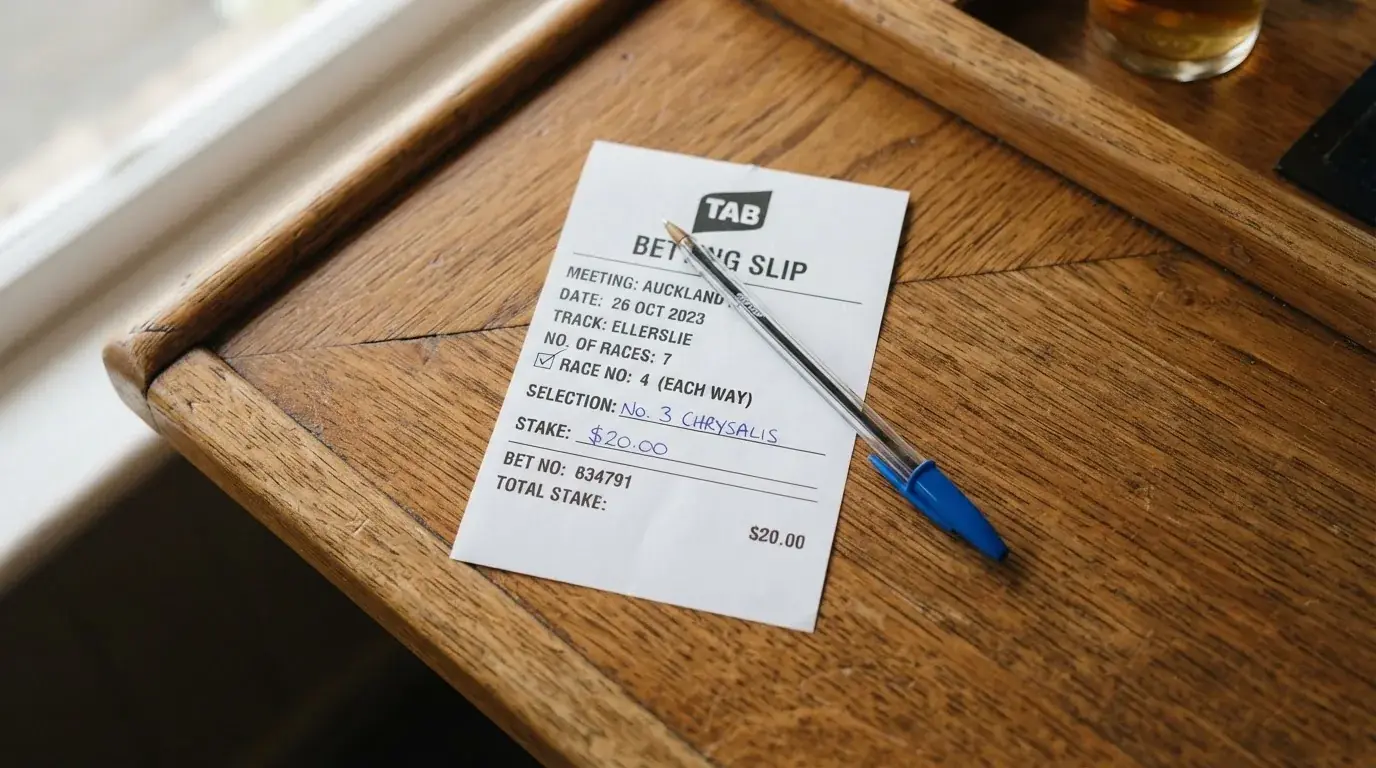
1. TAB — the New Zealand monopoly pair’s racing and sports product
TAB is one of two online brands operated by TAB NZ, the holder of the sole right to offer racing and sports betting in this jurisdiction under section 74AAA of the Racing Industry Act 2020. Entain runs the TAB business under a 25-year agreement signed in 2023, sharing gross profits 50/50 with TAB NZ, with at least $150m a year going to TAB NZ for the first five years and a one-off $100m payment from Entain to the racing sector.
The product covers horse and harness racing, rugby union and rugby league, and other sports, pre-match and live. Win, Place, Each Way, Quinella, Exacta, Trifecta, First Four, Double, Treble, Daily Double, Running Double, Quaddie and Big6, plus Multis and Same Game Multis. Trackside live race streaming runs in the app with in-app betting, and racing form, Blackbook and Jockey Challenge tools sit beside the bet slip. A simplified wallet handles deposits and withdrawals. Bonus bets and Bonus Cash promotions run through the app, including the Mega Multi bonus of up to $50 in Bonus Cash when a multi of four or more legs falls short by a set number of legs, with terms and conditions applying.
The cost is the cost of betting inside a regulated monopoly. The margin is the same margin any bookmaker charges on the same market. The identity verification is a one-off cost in time, not money. The harm-minimisation tools — deposit limits, time-outs, self-exclusion — are bundled in, and the free Gambling Helpline (0800 654 655, text 8006) and Safer Gambling Aotearoa sit beside them. That is what the New Zealand dollar buys here, and no other brand on this shortlist sells it.
2. Betcha — TAB NZ’s online sister brand, run by Entain
Betcha is the second of TAB NZ’s two online brands, and the amendment that took effect on 28 June 2025 names Betcha alongside TAB as one of the two brands that may lawfully accept wagers from people in New Zealand. Betcha is not a rival to TAB. It is the same operator group, with a different front-end and a younger product positioning.
The product draws on the same TAB NZ catalogue and the same Entain trading desk, with the same fixed-odds and pool betting, the same multis, and the same harm-minimisation framework. A punter who opens an account with TAB and an account with Betcha is opening two accounts inside one operator, and the operator’s self-exclusion applies across both.
The cost is identical to TAB. The bonus structure may differ between the two brands on a campaign-by-campaign basis; the rollover, the minimum price, the cap on free-bet winnings and the deadline are the four numbers a punter reads before claiming any of them. The verification, the wallet, the payout path and the harm-minimisation tools are the same.
3. 22Bet — Curaçao licence, not licensed in New Zealand
22Bet is run by TechSolutions Group N.V., a Curaçao company with registration number 144920, under Curaçao licence 8048/JAZ. TechSolutions also runs 20Bet, Bizzo and National Casino. The Curaçao licence gives no right to take bets from people in New Zealand; only TAB NZ may do that, and a Curaçao licence is the kind of jurisdiction the Department of Internal Affairs warns about when it tells punters overseas operators may not pay out large wins.
The product is broad: full sportsbook, casino, live dealer, esports, and a long list of payment methods that includes crypto. The welcome offer is the kind of headline that earns a closer read: the rollover, the minimum price, the eligible markets and the cap on free-bet winnings decide what the headline is actually worth. The cashier exposes more currencies than New Zealand dollars, and the FX cost is the punter’s to carry.
The cost is the legal position first. A New Zealand punter betting with 22Bet is betting with an operator the Department of Internal Affairs has told to withdraw, and there is no New Zealand complaints route if the payout stalls. The Curaçao licence is a piece of paper, not a New Zealand entitlement.
4. Telbet — crypto casino and sportsbook, no New Zealand licence
Telbet describes itself as a crypto casino and sportsbook, and its Russian-language site lists a welcome offer of 200% up to 1 BTC plus 50 free spins and a 5 USDT free bet. The welcome is the headline; the rollover, the minimum price, the eligible markets, the cap on free-bet winnings and the deadline are the cost.
There is no licence that applies in New Zealand. The brand names no Curaçao, Anjouan or Tobique licence; the absence of a licence number is itself a flag, because offshore brands that have a licence print the number. The absence leaves the punter with no regulator to escalate to, no matter where the regulator sits.
The cost is the same cost every offshore brand in this position charges: a deposit that may not be recoverable, a withdrawal that may pause for a source-of-funds check, a complaint with no domestic destination, and a marketing message designed to look like a New Zealand product without being one. The crypto rail does not change the legal position. Crypto is a payment method. The law targets the operator.
5. BetAlright — 18+ age gate, no New Zealand licence
BetAlright accepts customers aged 18 and over only and runs a separate partners site at Partnersbetalright. The 18+ gate is the kind of line every brand on the shortlist prints; the absence of a New Zealand licence is the line none of them prints. New Zealand law targets the operator; the age gate on the brand’s site is the operator’s own gate, not the New Zealand regulator’s.
The product is a sportsbook and casino under one account, with a welcome offer that follows the same shape as every other offshore brand on the shortlist: a headline, a rollover, a minimum price, an eligible-market list, a cap on free-bet winnings and a deadline. The punter reads the terms, not the banner.
The cost is the standard offshore cost: no domestic complaints route, no domestic harm-minimisation framework, and no legal protection if the payout stalls. The 18+ gate is not a New Zealand protection. It is the operator’s own policy.
6. Glorion — live chat and email support, no New Zealand licence
Glorion support is available by Live Chat or by email, and the site accepts customers aged 18 and over only. Support hours are not the same as New Zealand regulator oversight; a live chat agent in an offshore contact centre is not the Department of Internal Affairs.
The product is a sportsbook and casino with the standard offshore shape. The welcome offer follows the same pattern: a headline, a rollover, a minimum price, an eligible-market list, a cap on free-bet winnings, and a deadline. The punter reads the terms.
The cost is the same cost every offshore brand in this position charges: no New Zealand complaints route, no New Zealand harm-minimisation framework, and no legal protection if the payout stalls. A live chat is a customer-service channel, not a regulator.
7. LegendPlay — Anjouan licence, not licensed in New Zealand
LegendPlay accepts customers aged 18 and over only, and the brand names an Anjouan Gaming Authority licence. The Anjouan licence is a real piece of paperwork in the jurisdiction that issued it; it is not a New Zealand entitlement, and it does not change the Department of Internal Affairs’ position that an offshore operator taking bets from people in New Zealand is in breach of section 74AAA.
The product is a sportsbook and casino with the standard offshore shape. The welcome offer, the cashier, the rollover and the bonus terms follow the same pattern as the rest of the shortlist. The punter reads the terms.
The cost is the standard offshore cost: no New Zealand complaints route, no New Zealand harm-minimisation framework, and no legal protection if the payout stalls. The Anjouan licence is a foreign regulator’s paperwork, not a New Zealand one.
8. BigClash — Curaçao licence, esports and virtual sports
BigClash offers pre-match and live sports betting across international and local leagues, plus virtual sports and esports betting on FPS and MOBA titles. The Curaçao licence is 8048/JAZ, the same licence number that appears on 22Bet’s paperwork, which suggests shared ownership or shared licensing infrastructure on the Curaçao side. That is a Curaçao question; it is not a New Zealand one.
The esports question is the live wire. Whether esports betting counts as ‘sports betting’ under the Racing Industry Act 2020 is an open question, and a New Zealand punter betting on an esports market through an offshore bookmaker is in a legal grey zone the law does not answer cleanly. The Department of Internal Affairs’ warning about overseas operators applies regardless of the sporting code.
The cost is the standard offshore cost plus the esports question. A punter who bets esports on BigClash is betting through a Curaçao licence, with no New Zealand complaints route and a legal classification the law does not settle.
9. Sportaza — Anjouan and Tobique licences, conflicting paperwork
Sportaza’s footer states it is licensed and regulated by the Government of the Autonomous Island of Anjouan, Union of Comoros, under licence No. ALSI-202606064-FI2, while its terms (section 1.4) cite licence No. 0000067 issued by Tobique. Two licence numbers, two jurisdictions, one brand. Neither is a New Zealand entitlement.
The product is a sportsbook and casino with the standard offshore shape. The welcome offer, the cashier, the rollover and the bonus terms follow the same pattern as the rest of the shortlist. The punter reads the terms.
The cost is the standard offshore cost. The conflicting paperwork is a flag a careful punter reads; the average punter does not, and the brand’s marketing does not point it out.
10. Winz.io — Anjouan and Tobique licences under Novatrix SRL
Winz.io states in its footer that it holds a licence delivered by Anjouan and Tobique, and the holder is Novatrix SRL. Rooster.bet is operated by the same Novatrix SRL under the same Tobique Gaming Commission licence No. 0000002. RoyalistPlay is also operated by Novatrix SRL under the same Tobique licence No. 0000002, and lists e-gaming licence No. 0000002 from the Tobique Gaming Commission.
The pattern is a single Costa Rica company (registration number 3-102-893958) running multiple brand fronts, each with the same Tobique licence and slightly different Anjouan licences. None of those licences is a New Zealand entitlement. The Department of Internal Affairs’ position applies regardless of which Anjouan or Tobique number the footer prints.
The cost is the standard offshore cost. The pattern of multiple brands behind a single Costa Rica company is a flag a careful punter reads; the marketing does not point it out.
Comparison table: ten bookmakers a New Zealand reader meets
The table is a market comparison. It is not a recommendation and not a ranking. The “New Zealand status” column states the position under section 74AAA of the Racing Industry Act 2020. The “key terms” column states what each operator’s own terms say about the brand’s main offer or product.
| Brand | New Zealand status | Key terms the operator states |
|---|---|---|
| TAB | TAB NZ brand — lawful under section 74AAA | TAB NZ product: horse and harness racing, rugby union and league, multis, Same Game Multis, Place Extra, Trackside streaming, Bonus Cash |
| Betcha | TAB NZ brand — lawful under section 74AAA | Same TAB NZ product with a younger front-end positioning |
| 22Bet | Not licensed in New Zealand | Curaçao licence 8048/JAZ, holder TechSolutions Group N.V., registration 144920 |
| Telbet | Not licensed in New Zealand | Crypto casino and sportsbook; welcome offer of 200% up to 1 BTC plus 50 free spins and a 5 USDT free bet on its Russian-language site |
| BetAlright | Not licensed in New Zealand | 18+ only; partners site at Partnersbetalright |
| Glorion | Not licensed in New Zealand | 18+ only; support by Live Chat or email |
| LegendPlay | Not licensed in New Zealand | 18+ only; Anjouan Gaming Authority licence |
| BigClash | Not licensed in New Zealand | Curaçao licence 8048/JAZ; pre-match and live sports, virtual sports and esports on FPS and MOBA titles |
| Sportaza | Not licensed in New Zealand | Anjouan licence ALSI-202606064-FI2; terms cite Tobique licence 0000067 |
| Winz.io | Not licensed in New Zealand | Anjouan and Tobique licences; holder Novatrix SRL |
The table’s purpose is to put the two lawful brands beside the eight offshore brands in one view, so the legal difference is visible at a glance. The cost column is the legal status column. A New Zealand punter’s choice between the two groups is not a choice between two products; it is a choice between a regulated monopoly with New Zealand harm-minimisation tools and an unregulated offshore market with none.
The fundamentals: what a bookmaker is and what it does
A bookmaker is a business that takes bets from customers, prices the bets using its own odds, and pays out winnings (or keeps the stake) according to the outcome. The business earns its margin on every market by pricing the odds so the implied probabilities add up to more than 100 %. That is the only structural edge the book has. It does not predict outcomes; it prices them so that across many bets, the book keeps a slice.

Three terms cover the structure. Decimal odds are the format this page uses: a $10 stake at 2.10 returns $21 ($11 profit). Stake is the amount risked. Payout is the total returned on a winning bet — stake plus profit. Margin is the slice the book keeps on every market, expressed as a percentage of turnover. A 5 % margin market returns 95 % of every dollar wagered to punters across all outcomes, in the long run.
For a two-way market priced at 1.90 on each side, the payout share is , and the margin is 0.050, or 5 %. That is the band the better-priced mainstream markets sit inside, and it is the number the punter is paying every time they place a bet. The bookmaker does not need to predict the All Blacks to beat the Wallabies. It needs the margin.
Legality and regulation: who oversees what in New Zealand
The Department of Internal Affairs (DIA) is the gambling regulator under the Gambling Act 2003 and monitors compliance with the betting prohibition in section 92A of the Racing Industry Act 2020. The Racing Industry Act 2020 establishes TAB NZ as the sole provider of racing and sports betting in this jurisdiction. The Racing Industry Amendment Act 2025 inserted section 74AAA, which took effect on 28 June 2025: no person other than TAB NZ may offer racing betting, sports betting or other racing or sports betting to a person in New Zealand, regardless of where that person is resident or incorporated. DIA told providers serving New Zealand to withdraw with immediate effect.
There is no licensing route for another bookmaker and no licence register for betting, because there is only one lawful operator. The law does not geo-block offshore websites; it puts liability on the offshore operator. The player: section 19(4) of the Gambling Act 2003 (inserted in 2025) says an individual may not be convicted for placing a bet with an offshore betting operator in breach of section 74AAA; no source states a penalty for a player. The honest framing is the operator side: New Zealand law targets the operator, DIA warns players of the risks, no published penalty for a player was found.
The Online Casino Gambling Act 2026 licenses online casino gambling only and does not license sports betting. TAB New Zealand winning the right to apply for a casino licence does not extend the betting monopoly. Greyhound racing is closing in stages from 1 August 2026, and from that date offshore operators may not take bets on greyhound races either.
What may be bet on is racing and sports betting from TAB NZ only. TAB NZ takes fixed-odds and tote (pool) bets; the published betting rules define Win, Place, Each Way, Quinella, Exacta, Trifecta, First Four, Double, Treble, Daily Double, Running Double, Quaddie and Big6, and Multis and Same Game Multis. Live betting is listed in the TAB NZ apps; any statutory restriction on in-play markets is not established. No lawful New Zealand betting exchange exists and spread betting is outside TAB NZ’s sports-betting definition. Bets on politics and novelty markets are not established. There is no statutory per-bet cap; limits are TAB NZ’s own terms. The ban covers events held inside and outside New Zealand. Virtual (computer-simulated) sport is treated by the 2026 online casino law as casino gambling. Whether esports betting is “sports betting” under the Racing Industry Act is not established.
Advertising and bonuses fall under the Advertising Standards Authority’s Gambling Advertising Code: ads must not target children (under 14) or young people (14 to under 18), judged by context, appeal and expected audience (25% or more of the audience counts as significant where accurate data exists), must not encourage harm, and must be truthful with terms available. No New Zealand equivalent of a “whistle-to-whistle” ban for betting was found. TAB NZ runs “bonus bets” promotions; no New Zealand rule on bet-bonus size or wagering terms was found.
Tax sits on the operator side. TAB NZ pays the Problem Gambling Levy of 0.74% (in force from 1 July 2025 to 30 June 2028). Overseas operators supplying New Zealand residents pay online gambling duty (12% of profits since 1 July 2024, 16% from 1 January 2027); a duty being payable does not make an offer lawful. The point-of-consumption charge on offshore racing and sports bets ceased on 30 June 2026. On the player side, Inland Revenue guidance says recreational gambling winnings are generally not taxable and prize money from TAB horse, dog and trotting races is not taxable; a person who bets as a business is a different case.
Responsible gambling and the harm-minimisation framework TAB NZ is bound by
TAB NZ provides safer gambling tools in its app: deposit limits, time-outs and self-exclusion. An exclusion applies across both TAB NZ brands (TAB and Betcha). The age for TAB NZ betting is 18; betting under 18 is an offence under section 89 of the Racing Industry Act 2020. TAB NZ accounts need a verified New Zealand address and ID.
The free Gambling Helpline (0800 654 655) and the text line (8006) sit beside the app, alongside Safer Gambling Aotearoa. TAB NZ must keep the risks of problem and underage gambling minimised, and pays the Problem Gambling Levy of 0.74%. There is no single national online-betting exclusion register: the register the casino law will require is for online casinos only.
The offshore brands on this shortlist print their own 18+ gates and their own responsible-gambling pages. None of them is bound by the Problem Gambling Levy, none of them offers the Gambling Helpline alongside the cashier, and none of them exposes a New Zealand-address-verified self-exclusion across a regulated operator group. The harm-minimisation framework is the second cost a New Zealand punter pays when betting offshore, after the legal status. The first is the legal status. The second is the lack of a domestic framework when the betting stops being fun.
How to read this page if you are deciding where to bet
A New Zealand punter who decides to bet with TAB or Betcha is choosing a regulated monopoly with New Zealand identity verification, New Zealand harm-minimisation tools, a New Zealand complaints route, and a margin in line with the global market. The cost is the same cost any bookmaker charges: a margin on every market, and a rollover on every bonus.
A New Zealand punter who decides to bet with one of the offshore brands is choosing an unregulated market with no New Zealand complaints route, no New Zealand harm-minimisation framework, and a legal position the Department of Internal Affairs has stated clearly. The cost is the margin plus the legal exposure plus the payout risk plus the absence of a domestic safety net. The welcome offer is the cover charge.
The honest read of “best bookmakers in New Zealand” in 2026 is that the best two are the only two the law allows, and the rest are a market a New Zealand punter enters at their own cost. That is the page’s verdict, and it is the same verdict every section above points toward.
Frequently Asked Questions
How do bookmakers set their odds in practice?
Bookmakers build odds from three inputs: a probability estimate for each outcome, a margin added to keep the book in profit, and a liability adjustment based on the bets already placed. The probability estimate comes from the trading team’s model and the live market data; the margin is a percentage added across all outcomes so the implied probabilities sum to more than 100 %; the liability adjustment moves the price to balance the book once the bets are in. The margin is the only structural edge the book has, and it sits inside every price on the page.
Is there a system for beating bookmakers at football betting?
No system beats the margin in the long run. A bookmaker’s margin is the slice the book keeps on every market, and no betting system removes it. What a system can do is find mispriced events where the book’s probability estimate differs from the punter’s, and back those events consistently. The punter’s edge on any single match is small, the variance is large, and the margin compounds across every bet placed. A punter who treats betting as a system to beat the book is paying the margin and calling it research.
How does someone start a bookmaker in New Zealand?
A person who wants to start a bookmaker in New Zealand cannot apply for a betting licence, because there is no licence to apply for: section 74AAA of the Racing Industry Act 2020 names TAB NZ as the only operator that may offer such services in this market, and there is no register of betting licences because there is only one lawful operator. A person who wants to operate a betting business serving New Zealand residents from offshore is in breach of section 74AAA, and the Department of Internal Affairs has told providers serving New Zealand to withdraw. The honest read of the question is that the answer is the law itself: TAB NZ is the only lawful option.
Which bookmaker is allowed to take sports and racing wagers in this country?
TAB NZ is the only provider lawfully offering such services in this country under section 74AAA of the Racing Industry Act 2020, in force since 28 June 2025. TAB and Betcha are the two online brands of TAB NZ, run by Entain under a 25-year agreement signed in 2023. No other bookmaker may lawfully take online sports and racing wagers from people in New Zealand, regardless of where the bookmaker is licensed or where the punter is resident.
How is the return on a bet worked out from the stake and the odds?
For a single bet at decimal odds with stake , the return on a win is and the net profit is . A $10 stake at 2.10 returns $21, of which $11 is profit and $10 is the original stake. For a combination bet, the odds of the legs multiply into one price; a two-leg multi with legs at 1.80 and 2.20 carries combined odds of , and a $10 stake returns $39.60 on a win. The arithmetic does not care whether the bookmaker is regulated; the legal position does.
What is a bookmaker’s margin and how does it show up in the odds?
The margin is the slice the book keeps on every market, expressed as a percentage of turnover. For a two-way market at decimal odds and , the payout share is and the margin is minus that share. A market priced at 1.90 / 1.90 carries a payout share of about 95 % and a margin of about 5 %. A market priced at 1.80 / 2.00 carries a margin of about 5.3 %. The margin shows up in the odds every time; the punter who reads the odds reads the margin.
Prepared by the Nzbookmakers editorial staff.